
What does Valentine’s Day mean to you?
Sunday musings: The small and everyday choices that make our love visible in a conservative city

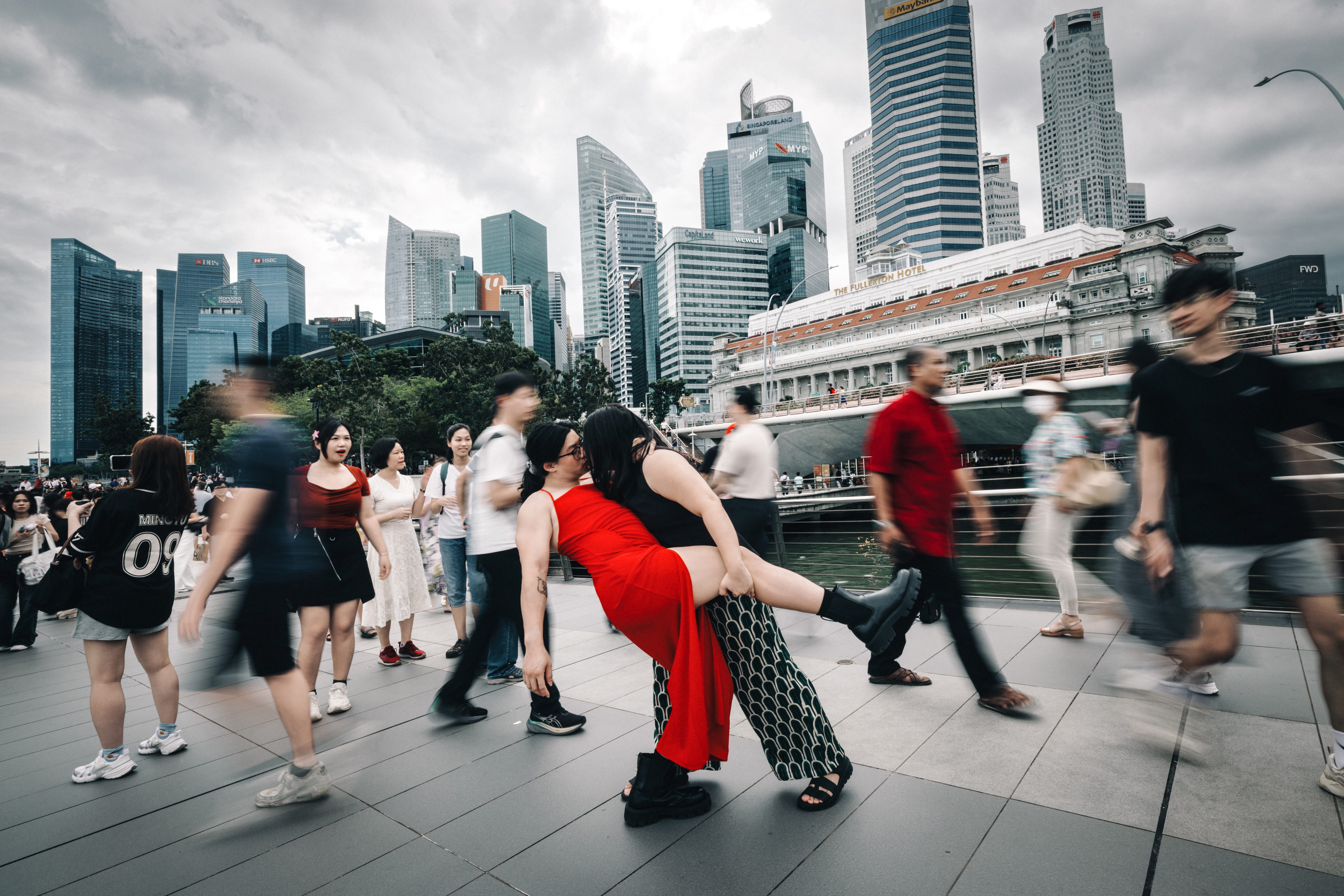
Valentine’s Day used to feel like a commercial script I was supposed to follow, with flowers, filtered photos, and a safe version of love that fit neatly into what people were comfortable seeing.
Still, over the past eight years with my wife, it has come to mean something far more confronting and far more honest, because loving loudly as an LGBTQIA+ couple in Singapore is still seen as controversial by some, especially when I am femme-presenting in a skirt with make-up on. We still choose to hold hands, hug, and show affection in public even when strangers stare.
We still do PDA when I am in full make-up, and we do not tone it down to make other people feel better, because visibility is not a phase for me, and love does not switch off depending on how masculine or feminine I look that day.
When my wife does my make-up before a shoot and carefully draws my eyeliner while we laugh about how much better she has gotten at matching my foundation shades from Sephora, it feels intimate in a way that has nothing to do with gender performance and everything to do with partnership, because beauty in our home is a shared ritual and not a rulebook.
We shop for clothes together, and sometimes I wear pieces she passes on to me, even though our wardrobes rarely overlap, since I love crop tops and mini skirts, and she does not. For me, clothing has always been a canvas for exploring who I am without apology.
I told her I was queer shortly after we started dating, and I was clear that I had dated different genders before, and her response was calm acceptance with no interrogation, no panic, and no attempt to shrink me into something more socially acceptable, which taught me that love built on the whole truth feels steadier than love built on selective disclosure.
We are raising our daughter outside narrow gender boxes because we want her imagination to grow wider than the roles we were handed. We never introduced traditional dolls and instead filled our home with educational toys, open-ended rainbow blocks, and even Gabby’s Dollhouse figurines that let her play without scripts.
When she imitates a doctor’s checkup or sets up her toys like a classroom, we see that she copies possibilities, not stereotypes, which tells us that children learn what they see repeated around them, and that we are careful about what we normalise.
We bring her to Pink Dot every year so she grows up seeing queer families and community as ordinary life rather than something whispered about, and those afternoons at Hong Lim Park surrounded by colour, laughter, and chosen family feel like quiet acts of resistance in a society that still debates our legitimacy. We also bring her into faith spaces that affirm who we are.
After growing up in churches that called my attraction a sin, I now attend Free Community Church in Singapore, where LGBTQIA+ people are welcomed without conditions, because I want her to learn that God is not an excuse for exclusion.
We train Muay Thai and Brazilian Jiu-Jitsu together because we believe in teaching her both softness and strength. While violence is never the answer, we want her to know how to stand her ground in a world that may misunderstand her, question her, or try to define her before she defines herself.
So when people ask what Valentine’s Day means to me, it is not about roses or restaurants, it is about choosing each other in public and in private, choosing honesty over convenience, choosing visibility over comfort, and choosing to build a home where love is expansive enough to hold eyeliner, faith, martial arts, rainbow blocks, and a child who will grow up knowing that authenticity is her starting point and not something she has to fight to reclaim.