
How Singapore's biggest property brand won by hiding its name
For comms teams and marketers, this is the trust sequence PropertyGuru used to beat a nine-figure ad budget with zero paid spend.

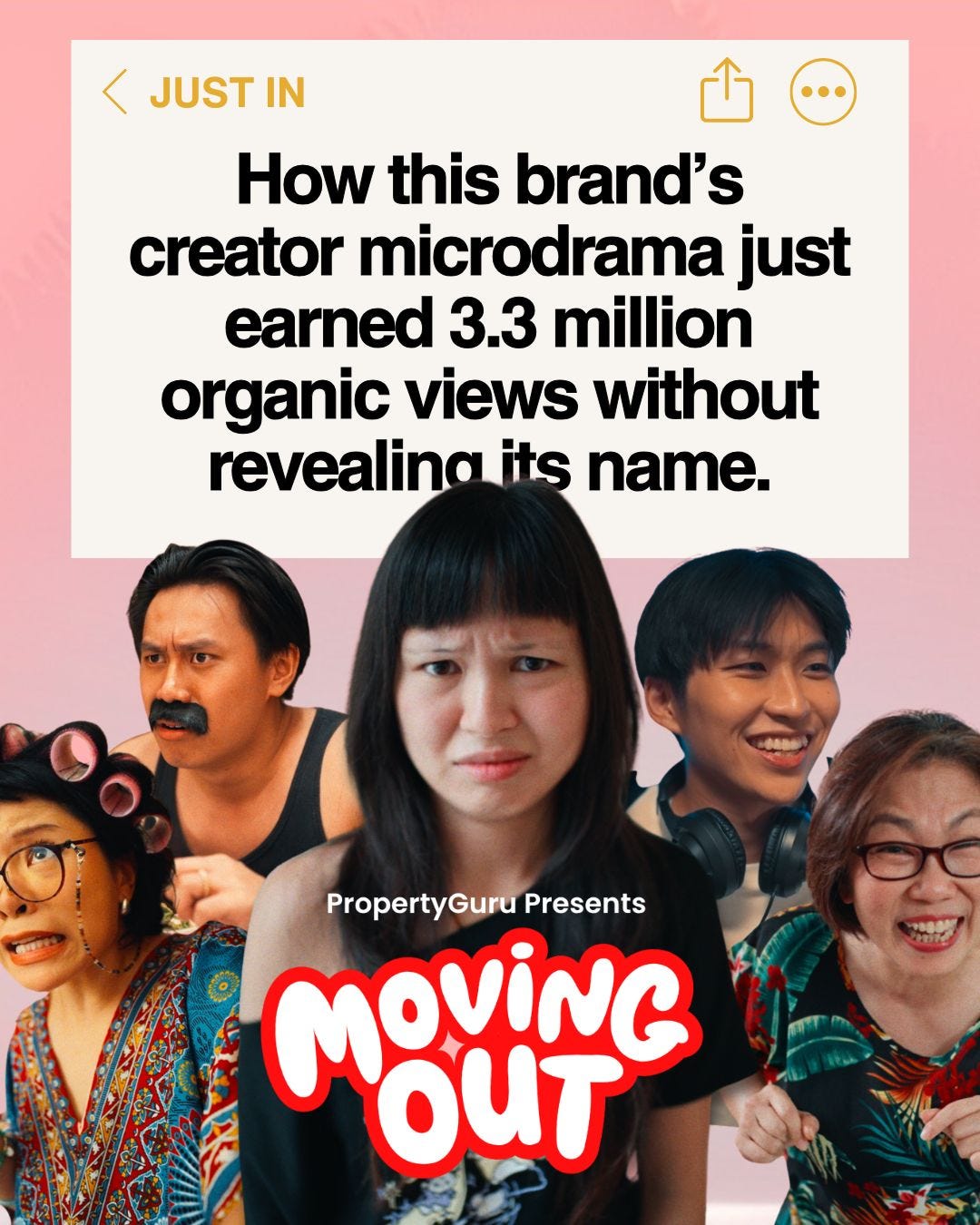
PropertyGuru owns 81% of Singapore’s property search market.
The company has a 5.7x traffic lead over the next closest competitor, which is the kind of dominance where you could put your logo on every MRT platform in the country and nobody would question why.
So when they launched a brand new show this year, they hid their own name.
They created a new TikTok account and Instagram account without any PropertyGuru branding in the bio, the captions, or the credits.
Then, they cross-posted across both, with zero paid amplification behind it and just a small cast of Singaporeans living through the very ordinary chaos of moving out of their parents’ place.
The PropertyGuru name didn’t show up until the finale.
However, by then, audiences had already followed these characters through arguments about independence, about what “home” means once you leave the one you grew up in, about the guilt of finally getting your own space.
They were watching people they had started to care about, instead of a brand campaign.
This is the part that is interesting because a company that didn’t need a single new customer to know its name chose to earn attention the hard way.
Real creators carried the cast with creators like Charlene Oh (SGTroller on TikTok) and Ryan Ang, who are names the audience already trusted before PropertyGuru ever entered the frame. The show hit one million organic views in 48 hours and by the finale, 3.3 million. All of it earned, none of it bought.
This matters beyond one show because the creator economy crossed $235 billion in 2026. In the first six months of this year alone, 70 companies bought their way into it through acquisitions, which is the strongest six-month stretch on record.
That means big, cash-rich companies are watching creators do something no ad budget can buy: getting believed.
This is a sequence, not a fluke, and once you see it, you can’t unsee it in every brand, founder, and creator winning attention right now.
I call it HALO: Human story first, Authority borrowed from people already trusted, Leverage that’s earned before it’s bought, and Offer revealed last.
PropertyGuru just proved it works with a nine-figure marketing budget behind it, while I proved it works with none.
The credential trap
Most brands and people building a personal brand get this order backwards.
They think authority has to be established before the story gets told.
For example, they feel they need to lead with the logo, market share, their title, degree, years of experience, the “as seen in” logos stacked at the bottom of the page.
The assumption is that credibility is a precondition for trust, something you prove before anyone’s allowed to like you.
PropertyGuru had every reason to make that mistake because they had the market share to brag about and the budget to buy every ad slot on every platform in Singapore.
Instead, they let creators tell a story about moving out, and allowed the audience to fall for the characters before they ever found out who was paying for it.
That is a great strategy because the aha moment buried in it is that the audience was already sold a story about growing up.
The brand only inherited the trust that story had already built, which meant that if PropertyGuru had opened with their own name, the same content would have registered as an ad the second it appeared on someone’s feed.
That is why hiding the name was the only way to let the story do its job before the brand asked for anything.
This is exactly what the sharpest minds in marketing right now are converging on, independently of each other.
Gary Vaynerchuk has been saying it on every stage he’s stood on this year: organic performance, not paid reach, is the only honest measure of whether content actually connects.
His line from a recent keynote has been stuck in my head for weeks — media shouldn’t be hiding bad creative. It should be amplifying good creative. Paid media was supposed to scale it once it already existed; it was never supposed to manufacture belief.
Alex Hormozi defines branding the same way, just from the numbers side, because to him, a brand is a deliberate pairing between your name and an outcome your audience already wants.
He built three billion organic impressions and sold $105 million in books in a single weekend, with zero paid ads behind the launch. The brand did the selling because the trust was already there before the offer showed up.
Steven Bartlett puts it perfectly, too: a brand is the sum of every experience a person has with you, and at scale, that experience becomes belief.
Belief is something you accumulate, one honest interaction at a time, until people trust you before they’ve even met you.
Look at Codie Sanchez too, who built an entire following on the same instinct. For example, she opened with a contrarian story like buying laundromats and vending machines while everyone else chased the polished Wall Street path and let the story do the convincing before she ever asked anyone to buy a course.
Even Dan Koe, who I would bet has never once thought about property listings, teaches something he calls the Trust Matrix: growth, authenticity, authority, in that order.
It is a different name, but with the same sequence I teach, which is that you prove you are real before you ask to be believed.
None of these people is saying “post more”, but they are all pointing at the same order.
I didn’t need PropertyGuru’s balance sheet to test this because I built my own business with no team behind me and no ad spend anywhere in the process.
Every client retainer and speaking invite came from a story people had already decided to trust, long before I had anything to sell them.
If the sequence holds with nothing, it holds with whatever resources you are sitting on right now.
The HALO playbook
You need the right order of HALO, not a market-leading budget.
Most people get stuck because they think this requires scale, when what it actually requires is sequence.
PropertyGuru had scale and still chose to earn attention the slow way, because they understood something most marketers skip past, which is that an audience can feel when they are being sold to before the sale ever happens.
Get the order right, and the sale becomes something people ask you for.
Here’s the sequence, broken into steps you can run with whatever you already have.
Lead with the Human Story
Before anyone knows whose story it is, they need a reason to care about it. PropertyGuru’s cast were arguing with roommates and calling their mothers about rent. That’s the entry point: a story specific enough that a stranger sees themselves in it.
Think of it like a doorway with no sign above it. People walk through because the room looks interesting, not because they know what’s inside. The pain point this solves is obvious once you’ve felt it: nobody clicks on an ad, but everybody clicks on a story that sounds like their own life.
Borrow Authority from people already trusted
PropertyGuru cast Charlene and Ryan, names their audience already believed before the brand showed up.
This is the step most founders skip because it feels like giving away credit, but it is the opposite. Trust is a currency, and the fastest way to earn it is to borrow it from someone who’s already spent years building theirs.
This is why a client testimonial does more work than a founder’s own claim and why a guest post from someone your audience already follows moves faster than 10 posts from your own account.
The metaphor here is simple, which is you are getting a loan from someone with a credit not building a bank from scratch.
Let Leverage be earned, not bought
Organic first and proof before promotion.
PropertyGuru let the show hit a million views before it ever needed a dollar of paid support behind it, and by the time the finale landed, the numbers were already doing what an ad budget never could — they were making people curious on their own.
This is the step that separates a brand people trust from a brand people tolerate. A boosted post says “we paid for your attention,” but an organically shared one says “people wanted this enough to pass it along themselves.”
One is rented, and the other is earned because rented attention disappears the moment you stop paying for it while earned attention compounds.
Reveal the Offer last
The name came in the finale, and by the time PropertyGuru revealed itself, the audience had already decided how they felt about the story, and the brand walked into a room that was already warm.
This is the step people rush the most, because waiting feels like leaving money on the table, but what they don’t realise is that the offer revealed too early gets read as a pitch.
The same offer revealed after trust is built gets read as a natural next step because timing decides whether the offer lands at all.
Audit your current order
Before you run the HALO framework, it’s worth a five-minute gut check.
Pull up your last three pieces of content and ask what came first: the story, or your name. Most brands and most personal brands run this sequence backwards without ever noticing, opening with the credential and hoping the story catches up.
If your name shows up before anyone has a reason to care, you’re already running the offer-first version of this, even if you didn’t mean to.
Forget about PropertyGuru’s market share or their production budget. You need to stop leading with your logo and start leading with the story that makes people forget there is a logo coming.