
A parade of scarves: Notes on fluidity and the diaspora
Award-winning published author Max Pasakorn pens a guest post for Human Algorithm on how living between identities taught them everything they knows about authentic storytelling.

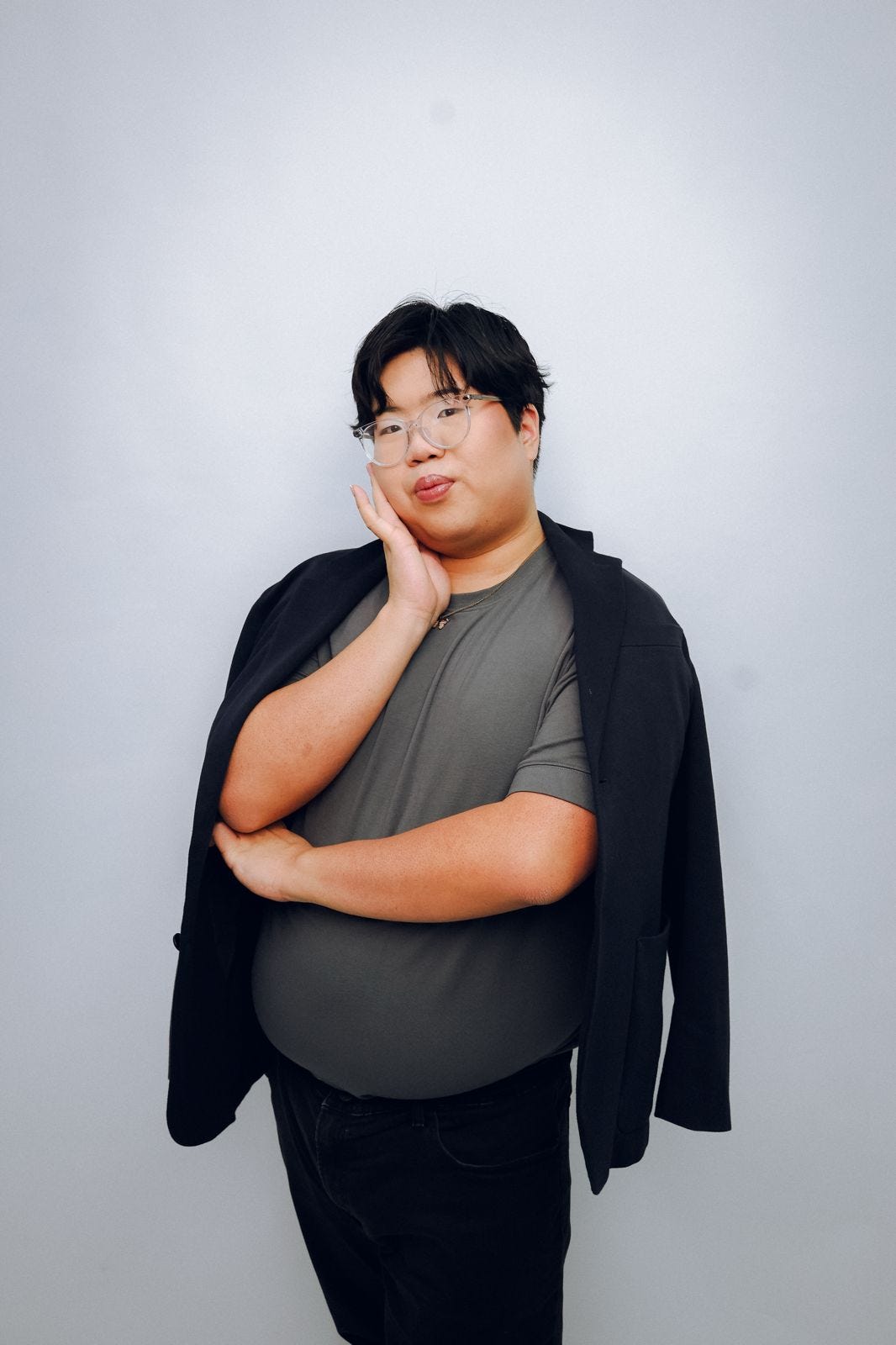
Max Pasakorn is an award-winning, published author of the creative nonfiction chapbook A Study in Our Selves (Neon Hemlock Press, 2023) and a Thai cultural translator with an average of 2 million monthly views on TikTok and Instagram. Max’s writing and social content explore the multiplicity of his identities as a Thai-born queer person who grew up in Singapore with English as his primary language. From a young age, he’s been writing poetry and creative nonfiction about his identity. Recently, he’s started unleashing those thoughts via video content on social media. Max has previously spoken at the Singapore Writers’ Festival and the Singapore Book Council. He’s currently the NAC-NLB Writers’ Lab Writer-in-Residence, where he’s working on his full-length debut memoir about growing up as a Thai third-culture kid in Singapore.
It is 2am on a Saturday morning. I have been partying so hard inside BEEF that the fake pieces of butchered meat hanging from the ceiling have started to look real. The club is crowded enough that, if the DJ played a Top 40 hit and I flailed my arms, I was sure to cause some kind of unwanted spill. So my body remembered what it was like to be in Singapore, courteous enough to keep myself in check so the crowd wouldn't look at me funny as a troublemaking tourist.
On the dance floor, beside me, a conversation started between two men with almost identical looks: stocky, with enough muscles to look like they ‘take care’ of themselves. I tuned out the music and into their words, certain I would recognise them, whatever language it was in. That was my superpower in the club, here in Bangkok. My trilingualism made me the perfect undercover spy. My parents didn’t name me after the titular character from the ‘80s American TV series MacGyver, best known for his resourcefulness for problem-solving, for nothing.
Sure enough, it was Mandarin Chinese, a language I had learned and dreaded throughout my early years of schooling in Singapore. All I remembered while studying the language were adults around me praising its future utility. Study Chinese and study hard, because you will need it for business with the Chinese diaspora when you grow up.
“Are you staying alone?” one guy eventually asks. Until that moment, I could not read whether he was being friendly or flirty. Mandarin always sounded a little too certain, as if expression were secondary to purpose. That was how I learned it, a utilitarian language, taught in primary school, so I could converse with others who couldn’t speak any other. But the characters I memorised from a dictionary were flat, and these were two real-life human beings attempting a kind of courtship, shoved underneath carefully chosen words. I didn’t hear hope through his words, but in his voice.
The other guy sips his drink. “With a friend.”
He puts his arm around the first man’s shoulders and leans in close to whisper into his ear. The first man blushes. They remain there, in half-embrace, for a long time.
This is Bangkok, I tell myself, as a Katseye song blasts through the speakers. “Where I want to call home.”
The trouble with being in between spaces, of being part of a diaspora, is that the world expects you to be certain and not half-hearted, binaristic rather than fluid. Planting one foot squarely in two cultures feels like your allegiance to each is constantly tested. My mother would scold me if I ever stepped on a raised threshold while entering a Thai temple. I was not supposed to exist in the in-between. Even if my identity was in flux, I learned to choose a side: cross into or stay out of a space. Then, perform that choice.
Am I Singaporean? By many definitions, yes. The hardest stamp of my Singaporeanness is the two years I reluctantly gave to National Service, the time when my income was so minuscule that I had to moonlight as an SEO copywriter to survive on weekends. I also went to school here and worked many jobs at local SMEs, where I learned how notoriously disciplined and hard-working Singaporeans are. I had Singaporean friends I played Mahjong with during Chinese New Year. Was that enough?
Am I Thai? Thailand is how I entered this world, gifted with a language so complexly beautiful I refused to give it up. While I watched dramas on Singapore’s Channel 8 (mostly so I could speak Mandarin the way my Chinese teacher wanted me to), I watched so much more Thai satellite TV. While she cooked, my mother and I watched so many sitcoms and comedy sketches. What I remembered about the Thai language was laughter. Unseriousness. Of realising how the twist of a phrase could lead to joy. Even if I could not write in it, Thai cracked me up, opened my love for creativity. Was that enough to call myself Thai?
As I navigated my adult life in Singapore, I began code-switching between Singaporean friend groups and expats. To some, I spoke perfect English. I told those people I was training to be a radio DJ at the polytechnic. To some, my English became Thai-accented. It was how I was supposed to sound. And to others, my English sounded so undeniably Singaporean, what you would hear from a 50-year-old uncle at a kopitiam. I’ve learned to live my life pulling these identities out like scarves from a magic box.
Over the years, as I navigated different stages of life, I could feel these scarves swirling from the recesses of my gut. Each time I encountered a new person who looked at me with that quizzical gaze, the one reserved for people they just didn’t intuitively understand, I’d find ways to add a new scarf so they would not. I would happily play grumpy, serious, ministerial Singaporean guy (with black-rimmed glasses) if it meant government workers would take me and my art more seriously. I could also play the globe-trotting executive with a multicultural background when I interviewed for jobs at multi-national companies. It was never an act of deception. These identities did exist. They were just folded neatly somewhere in the scarf box until I needed to pull them out.
Putting on these scarves made it easier for the world to perceive me. Because it did not raise unanswered questions, I could find allies more easily. Work, and therefore, life, would be smooth-sailing.
But, the more I wrote creative nonfiction about myself and my life, as I exposed my identity through the written word, the more I realised that the scarves I wear within these interpersonal conversations were pretty distractions from cementing my identity to the world, not as simply Thai, simply Singaporean or simply queer, but as an amalgamation of it all. On the page, I expressed what I could not in conversation. When there was no specific audience I needed to tailor my words for, I discovered my own vocabulary.
Once, I believed authenticity meant a complete understanding of myself. That was how I was taught in schools: do not put words on a page that you cannot defend. Yet, as I wrote, I became aware of shifts in my identity. Because prose has momentum, I would often note how my perspective shifts as I traverse the scenes of my life. Where I end is not where I begin.
This instability can scare many writers off the page. But acknowledging one’s constant state of flux is quite ingrained in me. I explore the concept of a constantly changing self artistically in one of my earliest creative nonfiction pieces, “Field Notes from an Investigation into the Self”, where a disembodied “self” represents how I’ve noticed myself changing over time.
Even as I write this essay, I am changing; I am acknowledging that, while I am jealous of the interaction between the two men I saw at BEEF, their story was never meant for my self-insertion. Because I am a non-fiction writer, every scene I write would be colored by what I inherently yearn for — not a romantic happy ending for what I see, but a state of emotional comfort for myself. I was not jealous that the interaction happened to someone else, but that I would likely not witness something similar again when I left BEEF, when I left Bangkok, and returned to Singapore. A state of normalcy where both queerness and a linguistic diaspora (two Chinese men in a Thai gay club) could co-exist with ease in the same space.
What I find most beginning non-fiction writers struggle with is a general unwillingness to cede their voice of authority. They feel they must enter a written work already understanding where they stand and who they are, and that the journey of the writing is a telegraphed act of revealing those aspects. Before they write, there is already an outline, and they’re just filling in the blanks. I do not blame them, for that is how they are taught to write, particularly with the five-paragraph college essay.
But I find that the most rewarding — and therefore, authentic — non-fiction is when you can tell that something clicked in the middle of the writer’s process. There is an “aha!” moment about their topic that wasn’t there before. That is the moment where readers perk up their ears (or eyes), because an unexpected energy flows into the text. They learn something about themselves as they are developing their thesis. And their selfhood evolves.
Being a diasporic and genderfluid writer means that this essayistic mode of inquiry is how my mind operates on a day-to-day basis. I wear a neat scarf when it would be dangerous not to, the way a turtle might crawl into its shell when attacked. But, away from judgmental stares, when I am let loose to wander this world as an authentic and unlabeled self, I am always finding new parameters to breach, new selves to grow into.
To be free in writing, we must treat writing as a canvas for freedom.
On every flight back to Bangkok, I make it a point to load my Spotify with Thai music, usually the latest Top 40 hits. I sometimes joke to my friends that I must study before I hit the club, the way a Singaporean student might “mug” before a big exam. But really, I treat it as a kind of emotional reset — to put myself in a stream of Thai words and of Thai artistry, and remind myself of where I was going. It was a ritual of transitioning, of recalibration. Of letting go of the version of Max I had put on while in Singapore, who felt priced out of a crowded and noisy city, and returning to an indisputably Thai version of Max. The one who was there on a holiday, not from work, but from someone whose feet became naturally muddy with Singaporean soil. It felt like a kind of cleansing.
On my most recent flight, I latched onto a song that has become Thailand’s top hit in the past few months: แก้บน by Karntong Tungngern. It was a love song, much like many Thai tracks that hit the top charts. But this one felt extra special. It was a song about wanting to be loved so bad, by the ideal person, that the singer was willing to do anything for it.
“When I land a good husband,” she sings, “I will dance to undo what I owe the deities.”
What struck me about this song was the over-the-top promise, the single-mindedness of doing anything not for one specific person, but to eventually find love.
Mouthing the words miles in the air, I wasn’t thinking of a lover. I had that already in Singapore. But I thought of how much I would give to be loved by the home I was about to land on. To be loved by Thailand, despite spending so many years away from her.
Each trip, I try to find signs of that love. With writers. In the clubs. With like-minded people, I meet. It never feels fully like a homecoming, but when you are part of the diaspora — here but away — you learn to sit squarely in that feeling of in-betweenness.
I write it out so I can show it, this beautiful braid of scarves I previously paraded for the world, only one at a time.
 | A guest post by
|